Why ski season is hard on knees
Skiing and snowboarding ask your knees to do something they rarely do the rest of the year: hold a bent, loaded position for hours while the ground moves under you. Add cold muscles, rented or unfamiliar gear, variable snow, and tired legs by mid-afternoon, and the knee becomes the joint that takes the stress.
Most people spend the fall running, golfing, or sitting at a desk, then show up on the first day of the season expecting their legs to cope. A few weeks of targeted preparation closes much of that gap.
What "knee stability" actually means
Stability is not just tight ligaments. It is your muscles and nervous system controlling the knee in motion:
- Strength in the quads, hamstrings, and glutes to absorb load.
- Endurance so control does not fade after the fifth run.
- Hip control so the knee does not collapse inward under load.
- Ankle mobility so the knee is not forced to make up for a stiff ankle.
- Balance and reaction so you can recover from an unexpected shift in the snow.
If any link is weak, the knee often pays for it.
A quick self-check
Try these before you start training. Stop if anything is painful.
- Single-leg squat to a chair. Do 5 slow reps on each leg. Watch for the knee drifting inward, the hip dropping, or one side clearly harder than the other.
- Single-leg balance, eyes open then closed. Aim for 30 seconds eyes open on each side. Compare left and right.
- Wall sit. Back against a wall, thighs near parallel. Note how long you can hold it. Ski days demand far more endurance than most people expect.
- Ankle knee-to-wall test. Foot flat, see how far your knee can travel past your toes before the heel lifts. Compare both sides.
A big difference between sides, or a result that surprises you, tells you where to start.
A six-week pre-season plan built around quads, hamstrings, and glutes
These three muscle groups do most of the work of holding you in a ski stance and controlling the knee. Train them two to three days a week, with at least a day between sessions, and add balance work most days. Build gradually, and change the emphasis to match the terrain you plan to ski.
The core strength exercises
Quadriceps (they hold the bent-knee stance and absorb impact)
- Box squat or goblet squat: 3 sets of 8 to 12, lowering slowly over 3 seconds.
- Split squat or reverse lunge: 3 sets of 8 per leg.
- Step-down from a low step: 3 sets of 8 per leg, knee tracking over the middle toes.
- Wall sit: 3 holds, building toward 60 to 90 seconds.
- Eccentric single-leg squat to a chair: 3 sets of 5 per leg, a 4-second descent.
Hamstrings (they protect the knee and share the load with the quads)
- Romanian deadlift: 3 sets of 8 to 10.
- Single-leg Romanian deadlift: 3 sets of 8 per leg, good for balance too.
- Hamstring bridge or slider curl: 3 sets of 8 to 12.
- Nordic hamstring lowering (advanced): 2 to 3 sets of 3 to 5 slow reps.
Glutes and hips (they keep the knee from collapsing inward)
- Hip thrust or glute bridge: 3 sets of 10 to 12.
- Banded lateral walk: 3 sets of 10 steps each way.
- Side-lying or banded hip abduction: 2 to 3 sets of 12 to 15.
- Lateral step-up: 3 sets of 8 per leg.
- Single-leg bridge: 3 sets of 8 to 10 per leg.
Match your training to the terrain
Different terrain loads the legs in different ways, so tune the intensity, rep range, and focus to what you will actually ski. Every program starts with the base above. Then add the emphasis that fits your plans.
Groomed runs: endurance and steady control
Long, steady turns demand sustained quad and glute endurance.
- Lighter load, higher reps: 2 to 3 sets of 15 to 20 on squats, lunges, and bridges.
- Wall sits and tempo squats (3 seconds down, 3 seconds up) to build time under tension.
- Moderate intensity, about 6 out of 10 effort, with short rests.
- Cardio base: 20 to 30 minutes on the bike or stair climber, two to three times a week.
Powder and off-piste: strength and power
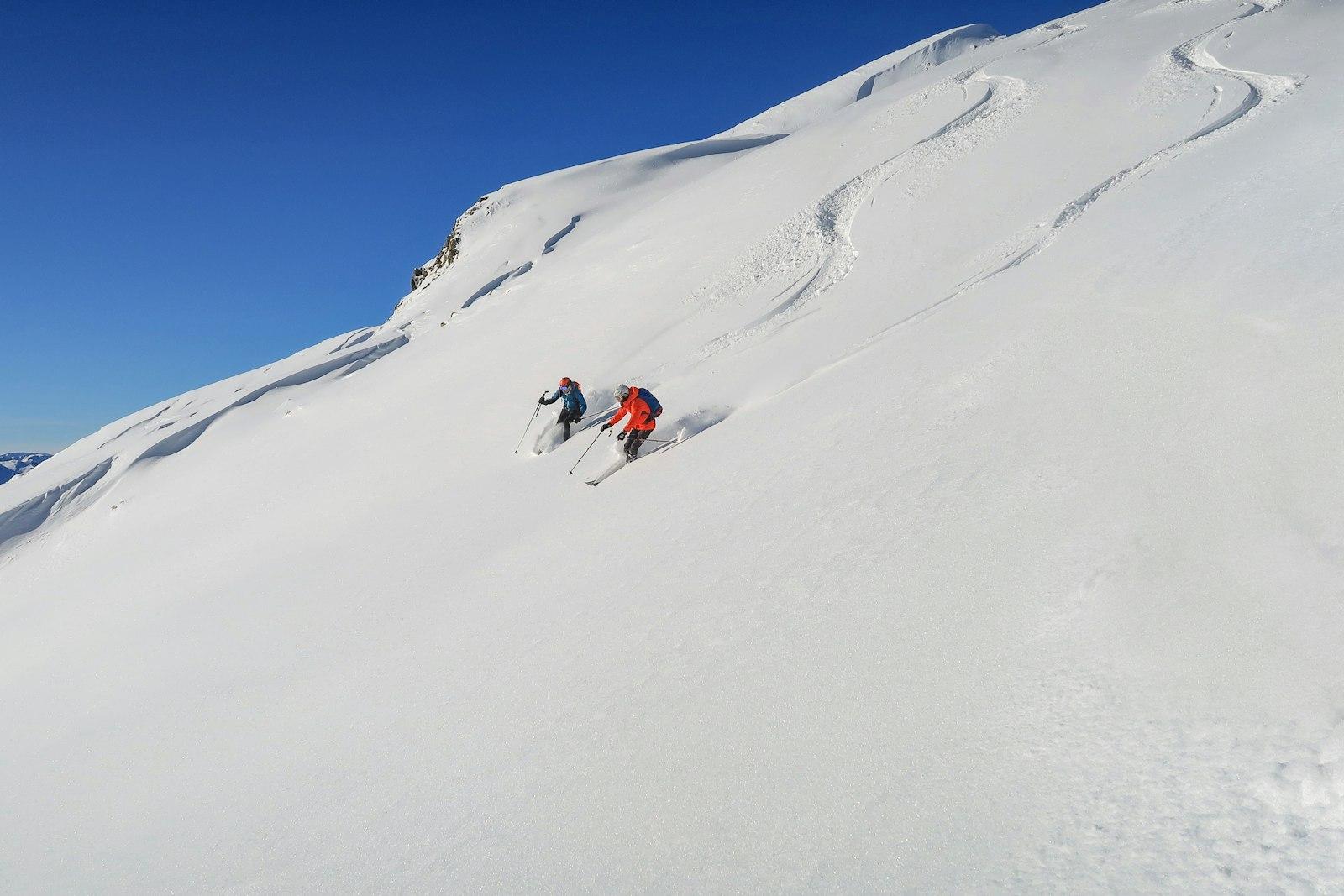
Variable, heavy snow asks for stronger legs, more hip drive, and quick recovery.
- Heavier load, lower reps: 3 to 4 sets of 5 to 8 on squats, Romanian deadlifts, and hip thrusts.
- Single-leg strength (split squats, single-leg deadlifts) because snow is uneven and you rarely load both legs equally.
- Eccentric work (slow lowering) for the quads and hamstrings.
- Moderate plyometrics (see below) for explosive extension out of the turn.
Moguls: maximum intensity, eccentric strength, and plyometrics
Moguls are the most demanding terrain for the knees. Your legs act like shock absorbers, repeatedly flexing deep to absorb each bump, then extending quickly. They need high eccentric quad strength, strong hamstrings and glutes for control, and fast, reactive power.
- Heavy eccentric quad work: 3 to 4 sets of 5 with a 4 to 5 second lowering phase on box squats, step-downs, and single-leg squats to a chair.
- Deep, controlled single-leg strength: split squats and lateral step-ups at a higher load.
- Strong hamstrings and glutes to control the knee and hip: heavy Romanian deadlifts, hip thrusts, and Nordic lowerings.
- Full plyometric progression (below), including the lateral and reactive drills.
- Higher overall intensity, about 8 out of 10 effort on strength sets, with 90 seconds to 2 minutes of rest.
- Leg endurance too. Moguls punish tired legs, so pair the heavy work with wall sits and bike intervals.
Quick terrain guide
- Groomers: 15 to 20 reps, light to moderate load. Focus on endurance and steady control.
- Powder and off-piste: 5 to 8 reps, heavy load. Focus on single-leg strength and power.
- Moguls: about 5 heavy reps with slow lowering, plus plyometrics. Focus on eccentric strength and reactive power.
Add plyometrics for the legs you need on snow
Plyometrics train your muscles and tendons to absorb and produce force quickly, which is exactly what skiing, and moguls in particular, demand. They also train the landing mechanics that help protect the knee. Build a strength base for a couple of weeks first, and do these only if you have no knee pain, swelling, or instability. Do plyometrics when you are fresh, not at the end of a tired workout.
Phase 1 (weeks 1 to 2): learn to land
- Squat jump with a soft landing: 3 sets of 5. Land quietly, knees over toes, hips back.
- Box step-off and stick the landing: 3 sets of 5 from a low box.
- Pogo hops (small ankle bounces): 3 sets of 20 seconds.
Phase 2 (weeks 3 to 4): add direction and speed
- Lateral bound (skater jump): 3 sets of 8 per side, sticking each landing.
- Split squat jump: 3 sets of 6 per leg.
- Forward-and-back line hops: 3 sets of 20 seconds.
- Lateral line hops, side to side over a line, to mimic turns.
Phase 3 (weeks 5 to 6): reactive power, for moguls and off-piste
- Box jump with a soft landing: 3 sets of 5, stepping down rather than jumping down.
- Single-leg hop and stick: 3 sets of 5 per leg.
- Tuck jumps: 3 sets of 5, if your landing control is solid.
- Mogul-style hops: quick forward and diagonal hops over low obstacles such as folded towels or a small cone, landing softly and recovering fast.
Plyometric guidelines
- Keep sets short and crisp. Quality matters more than quantity.
- Rest 60 to 90 seconds between sets.
- Do plyometrics no more than two days a week, with at least 48 hours between sessions.
- Stop if your landing gets sloppy, your knees drift inward, or you feel pain.
A sample week (moguls emphasis)
- Day 1: Heavy strength (squat, Romanian deadlift, hip thrust, step-downs), then balance work.
- Day 2: Bike or stair climber for endurance, plus wall sits and mobility.
- Day 3: Plyometrics, then single-leg strength and hip work.
- Day 4: Rest or easy walking and stretching.
- Day 5: Eccentric strength (slow single-leg squats, Nordic lowerings, lateral step-ups), then short plyometric hops.
- Weekend: Easy activity, and balance work.
For groomers, swap the heavy days for higher-rep sets and extend the cardio. For powder, sit between the two.
Balance and endurance
- Single-leg balance, progressing to eyes closed or standing on a pillow.
- Lateral shuffles and skater steps to mimic the demands of turning.
- Wall sits and cycling intervals to build the stamina to keep control late in the day.
On the mountain
- Warm up. Take an easy first run and do a few leg swings and bodyweight squats before you clip in.
- Fuel and hydrate. Tired, under-fueled legs lose control sooner.
- Know your stopping point. When your legs feel shaky or your form falls apart, call it a day. The last run is not worth a season.
- Check your gear. Properly fitted boots and correctly adjusted bindings matter, so have a qualified shop set them for your weight, height, and ability.
When to get checked before you ski
A knee evaluation first is the smart move if you notice:
- Swelling or stiffness that lingers.
- The knee giving way or feeling unstable.
- Catching, locking, or clicking with pain.
- Pain going up and down stairs or when squatting.
- One leg clearly weaker or less steady than the other.
- A previous ACL, meniscus, or ligament injury, or knee surgery.
At SC Sports Therapy, we look at how your knee, hip, ankle, and spine move together, find where control is breaking down, and build a plan to get you ready. If you are recovering from surgery, our post-surgical rehab program can help bridge you back to the slopes. For help getting ready, see our sports injury chiropractic care and our sports recovery membership.
This article is general education, not a diagnosis. If you have pain, swelling, or instability, get evaluated before you ski.